
Retiring in Spain as an American
Two retirees sit at a café in southern Spain. One is an American who's recently moved there, the other is a Spaniard who's lived there his entire life. Before retiring, they worked an equal number of years at equally high-paying jobs. So, why are their financial circumstances now so divergent?
Understanding the answer to that question is important for Americans retiring to Spain. Learning how locals retire can help us make better financial decisions in our new home. It also enables us to set realistic expectations, to gain insight into why, for example, Spanish retirees are less worried about healthcare than we are. And knowing the local retirement landscape helps us integrate rather than simply relocate, my favorite expression is, "Moving abroad changes our address. Understanding how locals retire changes our perspective."
The Three-Legged Stool vs. the One-Legged Stool
American families often build their retirement on a three-legged stool: employer-sponsored plans, Social Security, and personal savings. Spanish families, on the other hand, typically build retirement on one principal leg: Spain's public pension (Social Security) system.
Employer-Sponsored Plans: 31 Flavors vs. Vanilla with Sprinkles
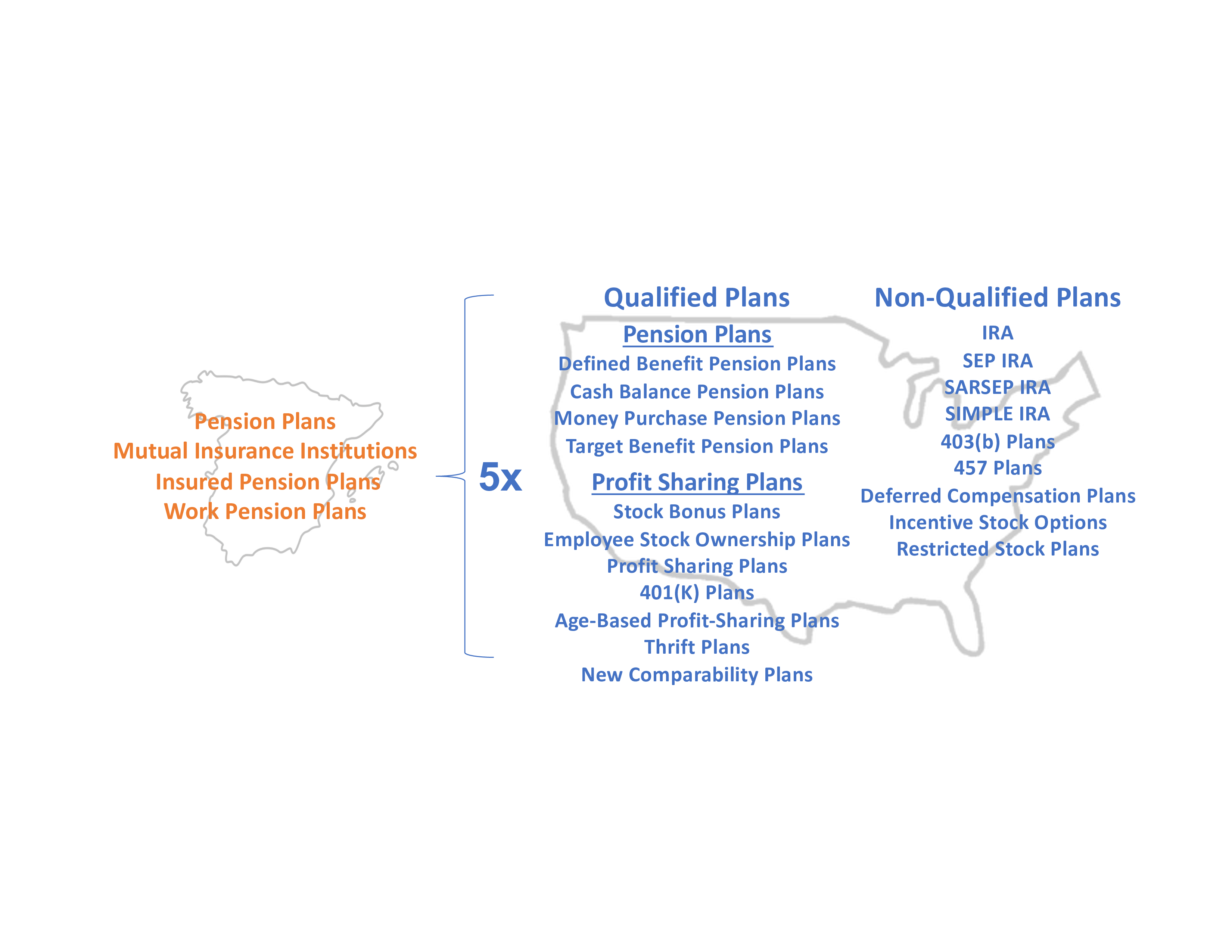
Choosing an employer retirement plan in the U.S. is like walking into an ice cream shop with 31 flavors. In Spain, on the other hand, when you ask what's available, the answer is: "Vanilla with sprinkles." The U.S. has qualified plans and non-qualified plans. Within the qualified plan category, there are Pension plans and Profit-sharing plans, that are further divided into defined contribution plans and defined benefit plans. Defined contribution plans can be either Pension or Profit-sharing. Defined benefit plans? They're always Pension plans.
U.S. companies can also establish non-qualified retirement plans, including one that has nothing to do with the employer, the IRA (Individual Retirement Account). This lets individuals save for their own retirement while still enjoying tax breaks. It's especially popular with self-employed workers who don't have access to employer-sponsored plans. Even employees with workplace retirement plans can utilize IRAs too, depending on their situation.
The list of options for tax-advantaged retirement savings is much shorter in Spain. The options are limited to pension plans, non-profit mutual insurance institutions, insured pension plans, and workplace pension plans. In broad terms, the United States has five times more tax-advantaged plans available for retirement savings than Spain does.
Social Security: A Meaningful Gap
The U.S. also has a higher Social Security ceiling than Spain. The maximum Social Security retirement pension in Spain in 2026 is €47,034.40, whereas in the United States it's €54,063 ($62,172 at today's euro/dollar exchange rate). That's a difference of a little more than €7,000 every year.
On top of that, U.S. Social Security payments receive more favorable tax treatment. This difference grows when we calculate the after-tax numbers. In Spain, these retirement payments are categorized as ordinary employment income and generally fully subject to income tax. In the U.S., only up to 85% of Social Security benefits (or less, depending on the recipient's income) are taxable.
And although taxes depend heavily on personal circumstances, income tax rates in Spain are typically higher than in the U.S. Making a reasonable apples-to-apples comparison means we'll need to make some assumptions: let's say our retirees are single, no other income, no special deductions or credits, average regional income tax in Spain, and the U.S. retiree has no state income tax, since many states exempt Social Security. In that case, the approximate after-tax Social Security maximum benefit for the Spaniard would be €39,500, whereas for the American it would be €49,565 ($57,000 at today's exchange rate). That's a difference of more than €10,000 ($11,575) that the American receives every year in retirement.
Personal Savings: IRAs vs. Planes de Pensión
The United States also offers much larger tax-advantaged personal retirement savings plans than Spain does. In 2026, many U.S. taxpayers can contribute up to $7,500 to an IRA ($8,600 if they've reached 50 or older) that can be deducted from their income taxes. In Spain, the maximum annual contribution to a "plan de pensión" eligible for a tax deduction is €1,500 (approximately $1,725). Some experts joke that Spain's plan is less of a retirement nest egg than a retirement starter kit.
Perspective Over Comparison
It's tempting to compare pensions, retirement accounts, and investment portfolios. But retirement financing isn't a competition, it's a reflection of the country in which we spent our working life. Retiring in Spain shouldn't simply be about enjoying a different country, it should also be about learning to see that country through the eyes of the people who have called it home all along.
Every retiree's exact mix of pensions, Social Security, and personal savings looks different once you actually run your own numbers, and turning a comparison like this into your own retirement plan is exactly the kind of thing worth talking through with someone. You can [SCHEDULE A PAID EXPAT EXPERT CALL | HTTPS://WWW.PASSPORTTOWEALTH.COM/ABOUT] to map out what this looks like for your specific situation.
You May Also Like
- Finding a Financial Advisor in Spain as an American: What You Need To Know First, Peter's other conversation on this site about what to look for before hiring anyone to manage your money in Spain
- U.S. Asset Planning Considerations for Americans Becoming Tax Resident in Spain, on the U.S.-asset side of the same move
- Spain Visa and Relocation Tips from a Pro Relocation Expert, for the logistics side of retiring in Spain
About the Author
Peter Dougherty is a U.S.-Spain cross-border financial planner and dual-certified CFP® and European Financial Planning Specialist, holding the highest financial planning credentials in both the United States and Spain. He works at BISSAN Wealth Management in Spain, where he specializes in advising Americans living in the country. Visit Peter's Advisor Profile to learn more or get in touch.