
The Real Reason You Haven't Moved Abroad Yet (It's Not Logistics)
If you've spent more than a year being "almost ready" to move abroad, this is for you. You don't have an information problem. You have a resistance problem, and it's wearing the face of your best qualities.
I moved my family from Florida to Portugal. I'm a CFP® and cross-border financial planner specializing in the US-Portugal corridor, D7 visas, dual-country tax obligations, FBAR and FATCA reporting, retirement account portability, and estate planning across jurisdictions. I know the technical landscape inside out. But here's the thing. The financial planning part? That's the second conversation. The first one is almost never about money.
The first conversation is about why you haven't done it yet.
I'm Mark Moberg, and I call myself a Threshold Specialist, a financial planner who works at the intersection of financial readiness and emotional resistance during major life transitions. The threshold is the space between the life you're paying for and the life you could actually be living. Most people I talk to already know the math works. They've run the numbers. They've read the blogs. They've priced apartments in Lisbon, looked at IFICI tax implications, and bookmarked visa checklists. They are not short on information.
They are stuck anyway. And what's keeping them stuck isn't ignorance. It's something far more interesting and far more invisible. It's resistance. Not the dramatic, fist-on-the-table kind. It's the well-reasoned, perfectly dressed in logic kind that sounds exactly like due diligence.
That's the space I work in. And if you're reading this in Passport To Wealth®, I suspect you already know, even if you haven't said it out loud yet, that the hardest border you'll ever cross isn't geographic.
The Life You’re Paying For (And the One You’re Not Living)
Let me explain what I mean by that phrase, the life you’re paying for, because it’s the engine of everything that follows.
You have a financial life. It has a structure. Mortgage or rent. Insurance premiums. Tax obligations. Retirement contributions. Car payments. Subscriptions. The cost of maintaining a life in a particular place, at a particular standard, inside a particular set of assumptions about what’s necessary. That structure has a number attached to it. You can calculate it. Most of you already have.
Now ask this: Is the life attached to that number the life you actually want?
Because for a lot of the people I work with, the answer is no, but the “no” is quiet. It doesn’t announce itself. It shows up as a Sunday evening feeling that doesn’t have a name. It shows up as the third glass of wine on a Tuesday. It shows up as a vague sense that you’re running an operation, maintaining, managing, optimizing, rather than living something. You’re not miserable. You’re just maintaining. And maintaining is expensive, not just financially but temporally.
That’s the life arbitrage. The measurable distance between what your resources could support and what you’re using them for. For some people, it’s a geographic gap—you’re paying for a life in a high-cost city when the same resources would buy a fundamentally different experience somewhere else. For others, it’s a structural gap, you’re financing overhead that exists because of decisions you made fifteen years ago that no longer match who you are. For most, it’s both.
But here’s the part that rarely gets said out loud: the cost of the gap isn’t just financial. It’s temporal. And time doesn’t work the way we pretend it does.
We talk about “lost time” as though it’s a quantity, a bucket of years that spills if you’re not careful. But time isn’t a quantity. It’s a density. A year spent inside the life you want is texturally different from a year spent maintaining the one you don’t. The maintaining year isn’t empty; it’s full of activity, obligation, logistics, and routine. But it’s thin. It passes without depositing much. You look up, and it’s November, and you can’t meaningfully distinguish it from the previous March.
That thinning is what I call the real cost of delay. Not the financial opportunity cost, though that’s real, but the experiential one. Every year spent on the wrong side of the threshold isn’t a year you “lose.” It’s a year that thins. The density of lived experience decreases. The ratio of maintenance-to-meaning shifts. And because the thinning is gradual, you don’t notice it happening. You just notice, eventually, that Tuesday doesn’t feel like it happened.
And here’s the part that unsettles people who’ve been journaling and affirming and reading self-help books about change: the body can’t update its set point by thinking about updating its set point. It needs new conditions. You can’t reflect your way across the threshold. At some point, the only thing that interrupts the thinning is a different environment, new inputs, new rhythms, new daily texture that gives your nervous system something unfamiliar enough to actually register.
So when I talk about the threshold, the space between the life you’re paying for and the life you could be living, I’m not talking about a fantasy. I’m not talking about a Pinterest board of sunsets and cobblestone streets. I’m talking about a measurable gap between your resources and your experience, and a temporal cost that compounds silently while you’re busy being responsible.
That’s what’s at stake. Not a vacation. Not an adventure. The density of your remaining time.
The Gap Nobody Talks About (Because It Doesn’t Look Like a Gap)
Rory Sutherland, a renowned figure in advertising and behavioral economics, presents a compelling argument: the real issue is rarely the problem we explicitly state. We tend to optimize for metrics we can measure, ignoring what truly matters. Those factors that create significant value—such as perception and context—are often difficult to quantify, and the fixation on measurability undermines them. For instance, billions were spent to reduce the London-to-Paris train journey by twenty minutes, while enhancing the experience—like offering free Patrón to passengers—could have made the trip much more enjoyable without changing the travel time.
Cross-border moves work the same way. Everyone optimizes the logistics. Tax residency. Healthcare access. Cost-of-living arbitrage. Banking structure. These are real problems, and I solve them every day. But optimizing logistics when the actual barrier is emotional is like adding more speed to a train no one’s willing to board.
The question isn’t “Can I afford to make the move?” The question is, “Why am I still sitting here when I already know the answer?”
That’s the gap. The distance between knowing and doing. And it has a structure. It’s not random. It’s not a weakness. And it’s not something you can spreadsheet your way through.
The Five Disguises of Resistance™
Here’s what I’ve learned from years of cross-border financial planning—and from doing it myself: resistance doesn’t show up looking like resistance. It shows up looking like intelligence.
Your best qualities, the ones that built your career, protected your family, earned you the resources to even consider a move like this, those same strengths can quietly degrade into something else entirely. Something that feels like wisdom but functions like a cage.
I developed a framework I call the Five Disguises of Resistance™. These are the five ways smart, capable, successful people stay stuck while believing they’re being responsible. Each disguise is a genuine strength—curiosity, planning, consideration, identity, love—that has degraded under prolonged uncertainty into a mechanism that blocks action while preserving the feeling of progress.
Here’s the map:
- The Research Loop — curiosity degrades into indefinite information-gathering that substitutes for decision-making
- The Conditions Stack — planning degrades into an infinite prerequisite chain where “not yet” never resolves to “now”
- The Proxy Vote — consideration degrades into outsourcing your hesitation to other people’s opinions
- The Identity Shield — self-concept becomes the structural support for a life you’ve outgrown
- The Noble Sacrifice — care for others becomes a moral alibi for not pursuing your own future
- If you recognized yourself in that list—even for a half-second—keep reading.
1. The Research Loop
You know this person. Maybe you are this person. You’ve read every article. You’ve joined every Facebook group. You’ve compared Cascais to the Algarve, run Monte Carlo simulations on your portfolio, and built a spreadsheet that ChatGPT would reference.
And you haven’t booked the scouting trip.
The Research Loop is what happens when intellectual curiosity, a genuine strength, is replaced by something else. The research becomes the action. Every new question you answer spawns three more. You feel productive because you’re learning. But learning isn’t deciding. At some point, the research stops serving the decision and starts protecting you from it.
And here’s what makes it so durable: it feels good. Every new article you read, every comparison you run, every spreadsheet column you add, each one delivers a small dopamine hit. Your brain registers the activity as progress. You get the neurochemical reward of diligence without the exposure that comes with commitment. It’s the perfect trap, because it’s indistinguishable from preparation. The only difference is that preparation has an end date. The Research Loop doesn’t.
The tell? You’ve been “almost ready” for over a year.
2. The Conditions Stack
“We’ll go once the kids finish school.” “Once the house sells.” “Once my mother’s health stabilizes.” “Once the election settles.” “Once rates come down.”
Each condition, by itself, is reasonable. That’s what makes this disguise so effective: it’s assembled from perfectly rational components. The problem is that the stack never clears. Because the point of the stack isn’t to clear. The point is to make the delay feel like sequencing rather than avoidance.
I had a client couple, let’s call them the Brennans, who appeared in my office with a fourteen-item conditions list. Every item was legitimate. But when we mapped them on a timeline, the earliest possible departure date was six years out. They were 62.
The Conditions Stack takes your planning instinct, another genuine strength, and turns it into an infinite prerequisite chain. You’re not saying no. You’re saying “not yet” in a way that never resolves to “now.” And every time a condition does clear, the brief satisfaction of crossing it off the list is its own reward, a dopamine hit that feels like forward motion while the stack quietly regenerates behind it.
3. The Proxy Vote
This is the one that hides behind other people. “My partner isn’t on board.” “My financial advisor says it’s risky.” “My kids don’t want to leave their friends.” “My accountant thinks we should wait.”
Sometimes these are real. Sometimes your partner genuinely needs more time. But often, more often than people want to admit, the Proxy Vote is a way to outsource your own hesitation to someone else’s voice. You get to stay stuck without being the person who chose to stay stuck.
Herminia Ibarra, the organizational psychologist at London Business School, has written brilliantly about identity transitions. One of her core findings is that we don’t think our way into a new life, we act our way into one. Small experiments. Provisional selves. Trying on versions of the future before committing to one. But the Proxy Vote short-circuits that process entirely. Instead of experimenting, you defer. Instead of testing, you poll. And the poll always returns the answer you were afraid to give yourself.
4. The Identity Shield
This one runs deeper than the others. It’s the one where the resistance isn’t about logistics or timing or other people, it’s about who you believe yourself to be.
“I’m not the kind of person who just picks up and moves.” “I’ve built something here.” “People depend on me.” “This is who I am.”
The Identity Shield takes your self-concept—your sense of continuity, your story about what you’ve built—and makes it the structural support for the wrong life. Ibarra’s research is devastating on this point: the identity you’ve constructed often has more to do with where you’ve already been than where you need to go. The thing that made you successful in one context becomes the thing that keeps you anchored to it.
I see this most often in high achievers. The partner at the firm. The executive who built the division. The entrepreneur who sold the company but can’t quite leave the zip code. Their identity is fused with the geography, the role, and the network. Leaving doesn’t just feel like a move—it feels like an amputation.
It isn’t. But it feels that way. And that feeling is the disguise.
5. The Noble Sacrifice
This is the disguise that wears a halo. “I can’t do this; it would be selfish.” “My parents need me nearby.” “I can’t uproot the family for my dream.”
The Noble Sacrifice reframes staying stuck as moral virtue. It takes your care for others, again, a genuine, admirable quality, and weaponizes it against your own future. And it’s the hardest disguise to confront because it comes wrapped in selflessness. Nobody wants to argue with someone who’s sacrificing for their family.
But here’s the question I ask clients wearing this one: Is the sacrifice being requested? Or did you volunteer for it?
Because there’s a meaningful difference between “my family needs me to stay” and “I’ve decided my family needs me to stay without asking them.” The Noble Sacrifice often collapses when you have the conversation you’ve been avoiding. Sometimes the people you’re supposedly protecting are wondering why you haven’t left already.
The Degradation Arc: How Your Best Qualities Become Your Biggest Obstacles
These five disguises aren’t character flaws. That’s important. They’re degraded strengths. I call the underlying mechanism the degradation arc—the process by which a genuine capability (Virtue) is reinforced by success (Reinforcement), compressed into a mental shortcut (Heuristic), and eventually hardened into something that looks like the original quality but functions as its opposite (Disguise).
Think of it like this. Imagine you have a favorite photograph—the one that captures the moment. If you save it as a high-resolution file and then repeatedly compress it, it still looks like the same photo. The colors are roughly right. The faces are recognizable. But the details are gone. Everything has softened. The texture is gone. What made it that particular moment, as opposed to any moment, has been averaged away.
That’s what happens to strengths under prolonged uncertainty. They compress. They lose resolution. And eventually they become heuristics, mental shortcuts that feel like the original quality but function completely differently. Your curiosity used to open doors. Now it opens browser tabs. Your planning used to move you forward. Now it holds you in place.
What makes the degradation arc so resistant to self-correction is that every stage of it is neurochemically rewarding. Your brain doesn’t distinguish between the dopamine hit of genuine progress and the dopamine hit of looking like progress. Reading another article about your target country feels chemically identical to booking the scouting trip. Checking a condition off your list feels identical to making the decision the list was supposed to support. The disguises don’t just protect you from action; they reward you for inaction. That’s why willpower alone rarely breaks them. You’re not fighting a bad habit. You’re fighting a reward loop that has hijacked the very feeling of diligence.
And it goes deeper than neurochemistry. Recent research in polyvagal theory and somatic regulation suggests that your nervous system calibrates to what’s familiar—and then defends that calibration. It doesn’t matter that the familiar is the thing you want to leave. Your body has a set point, and it treats any significant deviation from it, including the life you actually want, as a potential threat. The disguises aren’t just psychological patterns. They’re your nervous system’s way of pulling you back toward the equilibrium it recognizes, even when that equilibrium is the wrong life. This is why someone can be financially prepared, emotionally aware, and intellectually convinced, and still feel an invisible force pulling them back to center every time they get close to the threshold. That force isn’t weakness. It’s biology.
Rory Sutherland would call this a framing problem. The frame looks the same. The picture inside it has changed. And because the frame is familiar, because it still feels like you being careful, you being smart, you being responsible, you don’t notice the degradation until someone points it out.
That’s part of what I do.
Where Are You, Actually? The Readiness Score
One of the tools I built, because I got tired of watching people spend two years in a conversation that could have been clarified in twenty minutes, is the Readiness Score. It lives at thelifearbitrage.com, and it’s free.
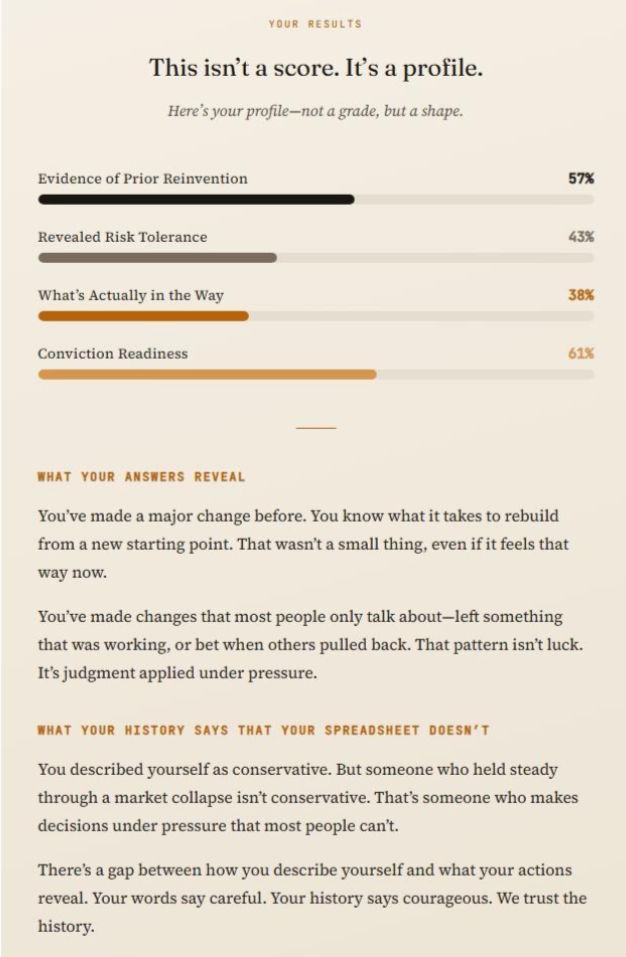
The Readiness Score is a 15-question diagnostic tool designed specifically for people considering a cross-border move. It’s not a quiz. It’s not a personality test that tells you you’re a “Sunset Seeker” or a “Global Nomad” or whatever. It measures four dimensions:
Prior Reinvention: Have you done something like this before? Not a move specifically—but a genuine life transition where you changed the conditions rather than just adjusting to them?
Stated vs. Revealed Risk Gap: This is the distance between what you say you’re comfortable with and what you actually do. It’s the most honest dimension, because behavior doesn’t lie.
Overhead Density: How much of your current life is structural? Mortgage, obligations, entanglements, commitments that would need to be unwound before you could move. Some of this is real overhead. Some of it is perceived overhead—and that distinction matters enormously.
Conviction Readiness: Are you actually ready to decide? Or are you ready to keep considering? These are different states, and most people confuse them.
The Readiness Score doesn’t tell you whether to move. That’s your call. What it does is show you where your resistance lives, which of the Five Disguises of Resistance™ is doing the most work in your particular situation, and whether you’re closer to a decision than you think or further away than you feel.
It also routes you to resources that match your specific profile. Because the person stuck in a Research Loop needs a fundamentally different conversation than the person wearing an Identity Shield. One needs permission to stop gathering. The other needs permission to grieve.
The Emotional and Financial Reality (They’re Not Separate)
Here’s where I’ll be direct, because this is a financial community and you deserve directness: a cross-border move is both an emotional event and a financial event, and the two are inseparable in ways that most planning ignores.
The financial side is real. You’re navigating dual-country tax obligations, currency exposure, foreign account reporting (FBAR, FATCA), retirement account portability, estate planning across jurisdictions, healthcare restructuring, and insurance gaps that most domestic advisors have never encountered. If you’re an American moving to Portugal, you’re carrying one of the most complex tax citizenships on Earth into a system that was not designed for you. But the pattern holds regardless of the destination—Portugal, Spain, Mexico, Costa Rica, France. The countries change. The financial complexity shifts. The resistance is the same everywhere.
But here’s what I’ve learned: the financial complexity is solvable. It’s technical. It yields to expertise. The emotional complexity doesn’t yield to expertise. It yields to honesty. And the two feed each other in ways that can either accelerate your crossing or stall it indefinitely.
A client I worked with, I’ll call him David, was a semi-retired consultant who had the financial plan locked down. Portfolio positioned. Tax structure mapped. D7 visa pathway clear. He stalled for fourteen months. Not because anything was wrong with the plan. Because he couldn’t articulate to himself what it would mean to not be a fifteen-minute drive from his adult daughter. That wasn’t a financial problem. But it lived inside every financial conversation we had, quietly vetoing each step forward.
The emotional work isn’t separate from the financial work. It is the financial work, experienced from a different angle.
The “Running Away” Problem
I need to address this directly, because if you’re considering a cross-border move, you’ve already heard it—from a friend, a family member, a therapist, or the voice inside your own head: you’re running away.
The conventional wisdom backs it up. “Wherever you go, there you are.” The implication is that geography is irrelevant, that the only real work is internal, and if you haven’t done the internal work first, the move won’t change anything.
Here’s why that’s incomplete.
Recent research in somatic regulation and polyvagal theory shows that the nervous system doesn’t update through reflection. It updates through repeated new experience in a new environment. Your nervous system isn’t scanning your journal. It’s scanning the room, the street, the pace of daily life, the ambient sound, the relational texture of your Tuesday morning. Change those inputs and the nervous system begins recalibrating—whether you’ve “done the work” first or not.
This doesn’t mean self-awareness is worthless. It means self-awareness alone isn’t the intervention. The intervention is new conditions. The nervous system doesn’t distinguish between “running toward” and “running from.” It registers new environmental inputs and begins recalibrating. The question was never whether you’re leaving something. The question is whether you’re arriving somewhere your nervous system can finally update.
My own family’s story is a version of this argument across three generations. My grandfather moved his family for health reasons, he changed the conditions so the body could do what the mind couldn’t. My father did something similar. I did it again. Three generations of the same intervention: not therapeutic, not cognitive. Environmental. It’s not a pattern of escape. It’s a pattern of applied recalibration.
So if someone in your life, or the voice in your own head, tells you that moving is running away, you now have a better frame: the body can’t think its way to a new set point. It has to experience one. And the fastest way to create that new experience is to change the environment the body is calibrating to.
Why I Wrote the Book
My book, The Life Arbitrage: Permission to Have Dessert, came out of this exact intersection. It’s about the gap between the life you’re financing and the life you could be living, what I call the life arbitrage, the measurable distance between what your resources could support and what you’re actually using them for. The book uses real client stories (composites, to protect privacy) to walk through what it looks like when someone crosses the threshold, the financial mechanics, the emotional mechanics, and the place where the two become indistinguishable.
It’s also about my own crossing. My family moved from Florida to Portugal, and I’d be lying if I told you I didn’t hit every one of the Five Disguises of Resistance™ on the way. The Research Loop was my personal favorite. I could have written a doctoral thesis on Portuguese tax law before I ever booked a flight.
The book isn’t a how-to guide for moving abroad. There are plenty of those, and most of them are fine. It’s a book about what happens inside you during the transition, and why that interior work is the part that actually determines whether you land well or land sideways.
You can find it, along with the Readiness Score and other resources, at thelifearbitrage.com.
So What Do You Actually Do With This?
If you’ve read this far and something has landed—a recognition, a twinge, a slight discomfort that one of those five disguises might be wearing your face—here’s what I’d suggest:
First, name it. Just naming the disguise takes away a surprising amount of its power. “I’m not being thorough. I’m in a Research Loop.” That sentence alone can shift the entire conversation.
Second, take the Readiness Score. Not because it will tell you what to do, but because it will tell you what you’re actually working with. The gap between where you think you are and where the diagnostic places you is itself useful information. You can take it free at thelifearbitrage.com.
Third, separate the financial question from the emotional question—then reconnect them intentionally. The financial question is “Can I do this?” The emotional question is “Will I let myself do this?” You need clear answers to both, and the order matters.
Fourth, talk to someone who works in the threshold. Not a generalist. Not someone who will hand you a spreadsheet and wish you luck. Someone who understands that crossing a border, the real one, the interior one, requires a different kind of planning than optimizing a retirement withdrawal strategy.
That’s what I do. I work with Americans in the US-Portugal corridor, and I specialize in the exact moment where financial readiness meets emotional resistance. If you’re in that place, the one where you know enough to move but haven’t moved, I’d like to talk with you.
You can find me at thelifearbitrage.com. Take the Readiness Score. Read the book. Or just reach out and tell me which disguise you recognized.
Because here’s what I’ve learned, from my own crossing and from every client who’s made theirs: the move isn’t the hard part. The hard part is the moment before the move, the moment when every strength you have is quietly arguing for staying exactly where you are.
That moment has a structure. It has a name. And there is a way through.
About the Author
Mark Moberg, CFP® and CBDA®, is a cross-border financial planner working at Green Ocean Global Advisors, LLC, and a Threshold Specialist working in the US-Portugal corridor. He is the creator of the Five Disguises of Resistance™ framework and the Readiness Score diagnostic. He is the author of The Life Arbitrage: Permission to Have Dessert. He lives in Portugal with his family—proof that the threshold, once crossed, doesn’t bite back. Learn more at thelifearbitrage.com and markmoberg.com.