
Navigating Japan's Tax System as a US Expat: A Practical Guide
New to Japan? Congratulations. Now, let's talk about the one thing your relocation guide probably glossed over: the tax bill. Navigating the intersection of the IRS and Japan's NTA is a high-stakes balancing act. If you're feeling the pressure, here is your roadmap to peace of mind.
Are You Exempt? SOFA Visa Holders, Read This First
If you work for the US Government or Military and entered Japan on a SOFA visa, you can stop here. You will continue to pay US taxes just like back home and are exempt from Japan's income tax system.

Who This Guide Is For
This article speaks to US Citizens who arrived on employment or spouse visas and have their residence card (Jūminhyō [住民票]). You are now obligated to pay income taxes under two systems, which can seem daunting at first, but like with anything in life, becomes less scary with knowledge and experience.
What You Can Exclude from Japan National Income Tax
First, let's break down what you can exclude from reporting on your Japan National Income Tax:
- US Military Pension Payments
- US State Level Pension Payments (CALPERS and other states)
- US Social Security Payments
Your First Five Years: Non-Permanent Resident (NPR) Status
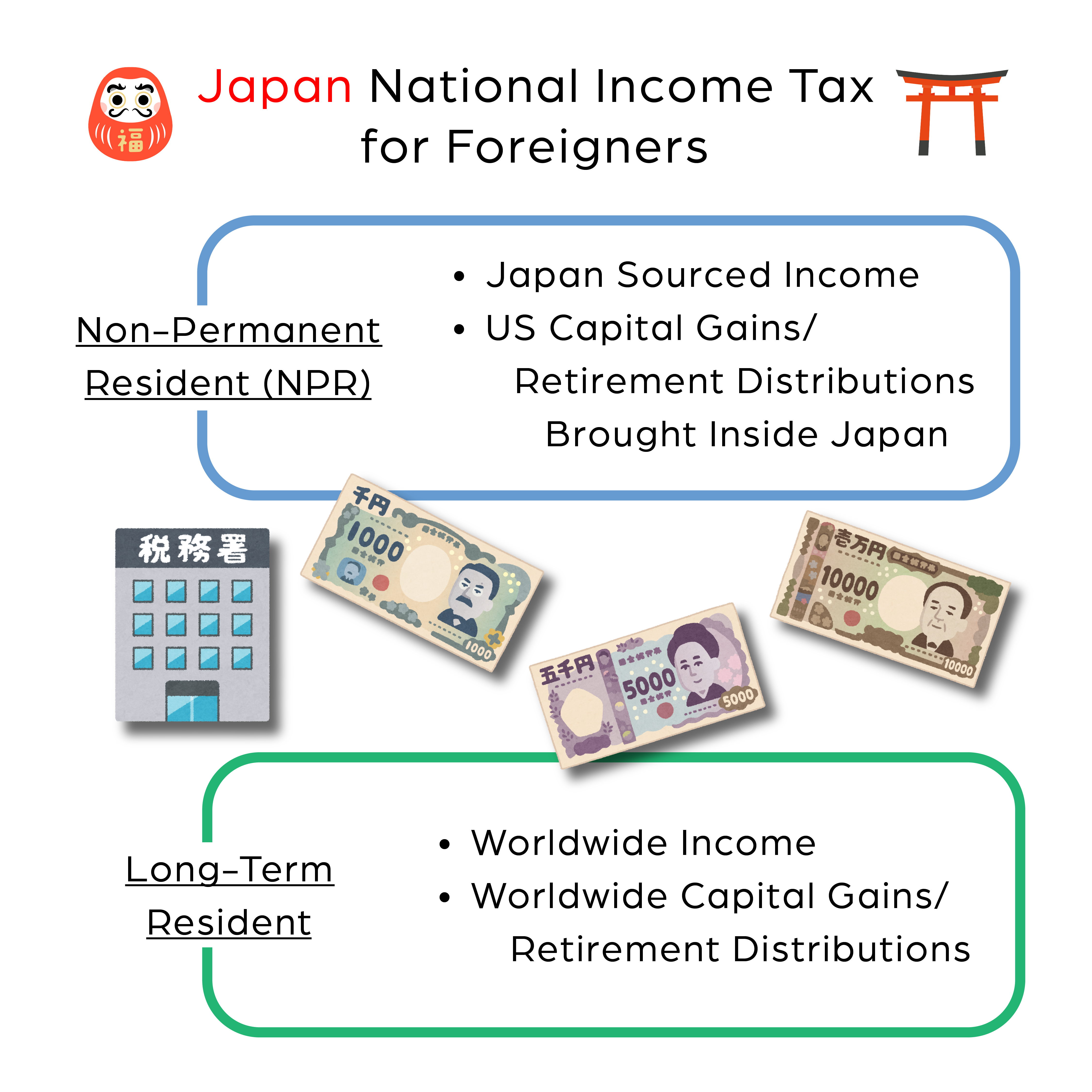
If you are newly arrived (in your first five years of residence) you are considered a Non-Permanent Resident (NPR) and only need to report "Japan-sourced" income:
- Local salary earned in Japan
- US-based self-employment income (when your physical body is in Japan when the income was earned)
- US-based capital gains, but only to the extent the amounts were remitted to Japan
- Retirement account distributions, but only to the extent the amounts were remitted to Japan
Understanding the "Remitted to Japan" Rule
A person might be confused about the "remitted" part. Say you bought TSLA stock in 2022 and sold in late 2025. In the meantime, you moved to Japan in early 2025. If you left the gain from the sale 100% in your US brokerage account, Japan doesn't touch it. However, if you can attribute a $5K cash transfer to your Japanese bank as a result of the sale, then you must report $5K as a capital gain on your Japan National Income Tax.
A retiree might be similarly confused: how do you report 401k/IRA distributions in Japan? Again, Japan only cares if you can attribute a Japanese bank transfer to these retirement accounts. And Japan only taxes the gain embedded in these accounts so you must have a rough idea of contributions vs. gain, so you don't end up paying tax on the full amount.
After Five Years: Japan's Worldwide Income Regime
Once you live here for more than five years, you are now under the regular Japanese income tax regime, and Japan taxes worldwide income. That means full disclosure of global income, capital gains (regardless of asset location), and retirement account distributions. No more carve-outs for remittances to Japan; only the special categories of US military pensions and US Social Security remain exempt.
How to File Your Japan Income Tax Return
With a Japanese-fluent spouse or friend, you can go down to the local tax office and file for free. Unlike the IRS, the government employees here help you fill out the form. This works well in most cases where the taxpayer has a straightforward situation.
If you have more complex capital gains sales or other issues, it's best to hire a professional. The local term for a licensed tax preparer is "Zeirishi", and you can find them on sites like Zei Navi.
The annual Japan tax deadline is March 15, so plan ahead!
You're Still Half Done: Filing US Taxes as an Expat
After filing in Japan, you are only half done. It's frustrating that the USA is one of the few countries to engage in "Citizenship-Based Taxation," so you are still obligated to file your annual 1040 and potentially pay US income tax — no matter where you live.
But mechanisms exist to mitigate or eliminate the effect of double taxation:
- Foreign Earned Income Exclusion (FEIE): Allows you to shield $132,900 (single) / $265,800 (married) [2026 rates] of locally earned income from US income tax.
- Foreign Tax Credit (FTC): Ensures part or all of your income tax paid to Japan is credited toward your US income taxes.
These two mechanisms largely wipe away your US income tax obligation each year.
Key US Filing Deadlines for Expats
The US income tax deadline for expats is June 15, yet the deadline for payment remains April 15. Work with your tax professional to determine if an estimated tax payment in April might be prudent.
About the Author
Andrew Haley, EA is a US Expat Financial Advisor and Enrolled Agent based in Japan, specializing in cross-border tax planning and financial advising for Americans living abroad. A US Navy veteran and expatriate himself, Andrew has lived in Japan twice; giving him genuine firsthand insight into everything covered in this article. Book a call with Andrew here.